Start at the End: A Practical Way to Build Your Theory of Change
In the not-for-profit sector, we’re often rewarded for activity – programs delivered, workshops held, people reached. But activity alone doesn’t tell us whether meaningful change is actually happening.
That’s where a Theory of Change comes in.
It’s much more than a logic model or a funding requirement. A Theory of Change is the story of how and why your work leads to real change. It connects the dots between effort and outcome – between what you do and the mission you exist to serve.
Without that clarity, evaluation starts to feel like guesswork. Success becomes a list of outputs instead of evidence of progress. And over time, even strong programs can drift, not because the work isn’t valuable, but because the pathway to impact isn’t clearly defined.
A clear Theory of Change brings focus. It aligns teams, strengthens decision-making, and gives funders confidence that your work is grounded in more than intention. Most importantly, it allows you to adapt without losing sight of what matters.
So where do you start?
Counterintuitively, the most effective approach is to start at the end.
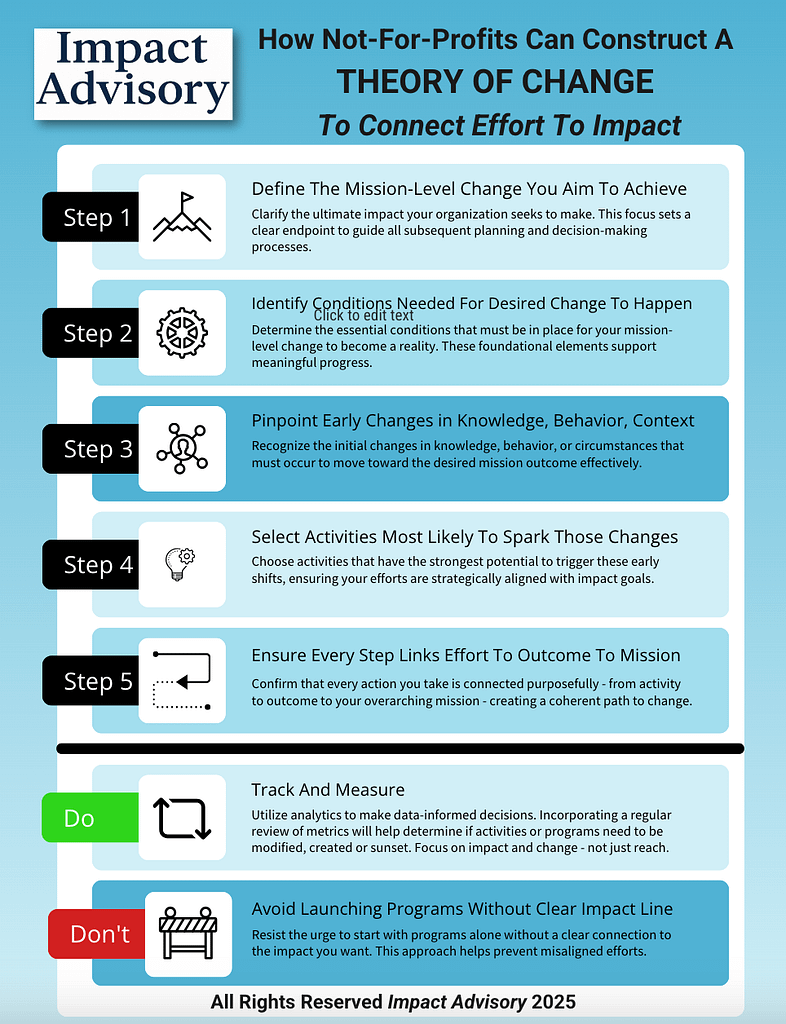
Begin with the mission-level change you’re trying to create. From there, work backward:
- What conditions must exist for that change to happen?
- What early shifts in knowledge, behaviour, or context are required?
- Which activities are most likely to spark those shifts?
This approach forces discipline. It ensures your programs are designed for impact, not just built from habit or urgency.
The framework below outlines this progression – from mission to activity – and reinforces a critical principle: every step in your work should clearly link effort to outcome, and outcome to mission.
At its core, a strong Theory of Change answers a simple but demanding question:
Can you clearly explain how your work creates change, and does your entire team understand it the same way?
If not, that’s where the real work begins.